I often find myself too scattered to be of much good. For some time now I've been writing into a leather-bound book, albeit sporadically, and I'd forgotten about my opportunities to write here. Since few people know about this effort, I imagine it's safe to keep something of a record of my thoughts and doings, helter-skelter as they are.
This morning June went to some sort of a health seminar on cancer with Mary Sweet, and I stayed home, managing to mow the front and side yards, buy a voltage tester (the garage electricity has gone out), take a nap in the afternoon, and do some reading in The Cloud of Unknowing. Having read it before, I'm surprised at how much I see upon this second (maybe third) reading.
Earlier in the morning I spoke at some length with CFI's Scott Mandl and brought him up-to-date of my efforts to assemble an itinerary for Ivy Salomon when she comes from Haiti to visit family and friends in the States. It's not as easy as I imagined; her family is spread out all over the U.S. and they too have busy lives that make it difficult for Ivy to drop by and stay for several weeks at just any time.
June and I are doing well as a married couple, even in our seventies. Tomorrow we plan to take Matt and Sara Beth Stout out to lunch somewhere in Nicholasville. I'm hoping we'll get to one of the morning Eucharists at Faith Lutheran Church. If not, then we'll spend the afternoon in Lexington and go to the evening contemplative Eucharist.
I need to study myself in the light of acedia and may get Kathleen Norris' new book on the subject.
Saturday, October 18, 2008

Monday, July 30, 2007
 Having returned from our family reunion, this year at Dauphin Island, I'm delighted that our family has been able to keep itself together. It's a real effort to gather everyone together because we are so separated geographically and at times spiritually. In spite of--or at times, I think, because of--our differences, the blood of us Harnacks runs thick and deep. As paterfamilias, I'm so privileged to have such a wonderful bunch of kids, grandchildren, nieces, and nephews. O yes, we argue a good bit (mostly about politics), but in the end there's always the huggings, the looking forward to seeing one another again, and the prayers that sustain us in our variety and differences. Some of us are politically conservative (yea, a libertarian!), others are liberal (listening, of all things, to NPR!), and others largely a-political. But in blood, and I like to think, in the blood of Christ, we are a real family. One, Carol, comes with enormous forgiveness in heart, and her presence is the light of Christ among us. Others come with professional preoccupations, overloads of work that don't disappear even on vacation times. Still others come as precious children, innocent of our family's history, but eager and willing to be lilke the children about whom Jesus says "are of the kingdom of God." For all who came to this year's week-long reunion, I give heartfelt thanks to God for their presence, their determination to keep the tradition going, and their holding of hands in prayer and in grace before our meals. It's all quite wonderful!
Saturday, July 14, 2007
Withdrawing Troops from Iraq
 For a good while I have been deeply appreciative of Daniel B. Clendenin, long-time associate with InterVarsity Christian Fellowship and founder of The Journey with Jesus: Notes to Myself, especially his weekly essay on the Biblical lectionary. As to why I had not noticed it before, I don't know, but yesterday I discovered One Million Blogs for Peace: To End the Iraq War. Inasmuch as I have been been opposed to the Iraq War months preceeding Bush's invasion on March 19, 2003 and watched in horror at our nation's celebration of "Shock and Awe" and have strongly opposed the war ever since, I wish to identify myself with those opposing the war in One Million Blogs for Peace. I have therefore signed online the blog's pledge:
 I believe in the immediate withdrawal of all foreign combat troops from the nation of Iraq. I believe in using my blog, in whole or in part, as a tool
toward this end.
To understand why I and other hundreds of thousands--millions of people worldwide--are convinced that we should remove our troops from Iraq now, visit the following sites:
For a rehearsal of the disasterous program of Bush, Chaney, Rumsfeld ("We know where the WMD are"), Rice, Wolfowitz, and other neo-cons have instigated, see the timeline.
Monday, November 27, 2006
November 28
 June and I drove from Georgia to Kentucky today; we got in about 6:30 p.m.
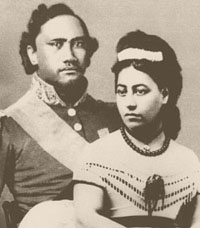
This evening begins the Commemoration of Kamehameha and Emma, King and Queen of Hawaii, 1864, 1865. When in Hawaii earlier this year, I heard a little bit about them, but remembered nothing substantial. Here's what I now know:
Within a year of ascending the throne in 1855, the twenty year old King Kamehameha IV and his bride, Emma Rooke, embarked on the path of altruism and unassuming humility for which they have been revered by their people. The year before, Honolulu, and especially its native Hawaiians, had been horribly afflicted with smallpox. The people, accustomed to a royalty which ruled with pomp and power, were confronted instead by a king and queen who went about, "with notebook in hand," soliciting from the rich and poor funds to build a hospital. Queen's Hospital, named for Emma, is not the largest civilian hospital in Hawaii.
In 1860, the king and queen petitioned the Bishop of Oxford to send missionaries to establish the Anglican Church in Hawaii. The king's interest came through a boyhood tour of England where he had seen, in the stately beauty of Anglican liturgy, a quality that seemed attuned to the gentle beauty of the Hawaiian spirit. England responded by sending the Rt. Rev. Thomas N. Staley and two priests. They arrived on October 11, 1862, and the king and queen were confirmed a month later, on November 28, 1862. They then began preparations for a cathedral and school, and the king set about to translate The Book of Common Prayer and much of the Hymnal .
Kamehameha's life was marred by the tragic death of his four year old son and only child, in 1863. He seemed unable to survive his sadness, although a sermon he preached after his son's death expresses a hope and faith that is eloquent and profound. His own death took place only a year after his son's, in 1864. Emma declined to rule; instead, she committed her life to good works. She was responsible for schools, churches, and efforts on behalf of the poor and sick. She traveled several times to England and the Continent to raise funds, and became a favorite of Queen Victoria's. Archbishop Longley of Canterbury, remarked upon her visit to Lambeth: "I was much struck by the cultivation of her mind...But what excited my interest the most was her almost saintly piety."
The Cathedral was completed after Emma died. It was named St. Andrew's in memory of the king, who died on that Saint's day. Among the Hawaiian people, Emma is still refered to as "our beloved Queen."
Proper:Acts 17:22-31Psalm 33:12-22 or 97:1-2, 7-12Matthew 25:31-40
O Sovereign God, who raised up King Kamehameha IV and Queen Emma to be rulers of Hawaii, and didst inspire and enable them to be diligen in good works for the welfare of their people and the good of thy Church: Receive our thanks for their witness to the Gospel; and grant that we, with them, may attain to the crown of glory that fadeth not away; through Jesus Christ our Lord, who liveth and reigneth with thee and the Holy Spirit ever, one God, world without end.
Amen.
I'm also back in Kentucky from my trip to Haiti for several weeks and have much to write about--later. Ont he way home June bought a French coffee press for Andy and Anna. I need to mail it to them asap.
Tuesday, October 31, 2006
Tuesday, October 31

John N. Day's "The Pillars of Imprecation: How to Pray for Your Enemies by Praying Against Them" in Touchstone: A Journal of Mere Christianity (November 2006) gives us a fine essay on how we might pray those psalms which ask God to destroy those who oppress and terrorize us. Day's essay focuses on Psalm 83, the very psalm which The Daily Prayer of the Church asks us to use on Mondays in Week I.
When praying such a psalm, Day urges us to place our imprecations before God as follows:
- only is settings of extreme enmity (as, for example, in Dafur)
- only while we practice persistant love of God and mankind (Matthew 22.37-39)
- only as we relinquish all personal desires of revenge (Leviticus 19.18)
- only as we appeal to God who has told that He alone is the Avenger (Deauteronomy 32.35)
- only as we plead with "the perfected saints in heaven" (Revelation 6.9-11)
O God, in your mercy You have promised to deliver suffering and oppressed peoples from the hands of those who hate you; as we live between Your command to love our enemies and Your promises to undo those who murder, rape, and pillage the innocent, we ask that You fill those who are evil with shame that they may seek Your name and repent of their evil; seeking to be obedient to your will and forsaking every personal desire for retaliation, we implore You to execute Your divine justice for the sake of those who suffer oppression; within the Company of Heaven and in the love and justice of Christ, we offer ourselves and these petitions through the same Jesus Christ, who lives and rules with You and the Holy Spirit forever.
If you would like to read Day's essay, let me know. And let me know how the collect above might be improved so that I might learn how to pray for my enemies while praying to God against them.
Sunday, October 29, 2006
October 29, 2006
 Yesterday Chelsea ran her best personal 5k at Masterson Park in Lexington: 23 minutes, 16 seconds. During the race she was in considerable pain, pain in both of her lower ribsides. So proud of her! Later in the afternoon I took her to a party at First Baptist Church where with some of her friends they played cards and went to Starbucks afterwards. Before going to bed, June, Chelsea, and I prayed for Harold and for the people of Dafur. Then we turned our clocks back an hour and went to bed.
Tuesday, September 05, 2006
Pentecost 17: Tuesday, 5 September 2006
 Matins outside early. Have decided to go to Haiti, November 14-21. It's okay with June; in fact, she encourages me. Perhaps need to update beneficiaries documents. Weeded front garden and cut shrubs; sweaty. Saw a female velvet ant on the driveway.
Monday, September 04, 2006
Pentecost 17: Monday, 4 September 2006
It's been a long time since posting; since my last, I've had to have the laptop repaired, June had her car accident (two weeks ago), and my two online classes are well underway. I've started reading The Brothers Karamozov. More importantly, I've become overly judgmental about a number of issues and desparately need to re-order the priorities of my heart and head. For the time being I'm taking a vow not to say anything controversial about liturgies and politics. Prayer must become more intense, more contemplative.
Chelsea was with us this weekend; she's a saving grace. Yesterdday we saw The Illusionist. Good movie. The Eucharist at Faith Lutheran Church was comforting; Pastor's homily on kicking dogs was to the point. The Gospel is hard to put into practice. I'm too insistant, especially with June. Must quit reading John 6 to her and simply act with Jesus, the true Bread, in my guts. Getting up before dawn will help.
Read Chekhov's "Gooseberries." Searing. So much like Ivan. Those raindrops on the window hammer for me. Am seriously thinking about going to Haiti in November.
Chelsea was with us this weekend; she's a saving grace. Yesterdday we saw The Illusionist. Good movie. The Eucharist at Faith Lutheran Church was comforting; Pastor's homily on kicking dogs was to the point. The Gospel is hard to put into practice. I'm too insistant, especially with June. Must quit reading John 6 to her and simply act with Jesus, the true Bread, in my guts. Getting up before dawn will help.
Read Chekhov's "Gooseberries." Searing. So much like Ivan. Those raindrops on the window hammer for me. Am seriously thinking about going to Haiti in November.
Friday, July 21, 2006
Pentecost 6 / Friday, July 21
Gordon and I fished off the dock last evening until it got too dark to see. We've heard from Carole that her physician has reason to think she has some kind of lung cancer. A PET scan is required and after that, next Monday, a team of doctors will evaluate things and make recommendations on what to do. When I came into the bedroom, June was praying the psalms and together we said Evening Prayer, doing the Litany slowly. The reading from Matthew 20 about the two blind men whom Jesus healed was good to hear. I rose again early this morning and said Morning Prayer on the deck. Psalm 88, "O Lord, I cry to you for help in the morning my prayer comes before you." Zonnie and June have gone off to the peach packing plant while Gordon and I are at home; he's resting, trying to find some relief from his chronic back pain. Am reading "Who's Afraid of Post-Modernism? Good book.
Wednesday, July 19, 2006
Pentecost 6 / Thursday, July 20
Zonnie arrived. We grilled vegetables and fish and ate together. She is doing well, maturing quite wonderfully. A wind across the lake this evening. Began Thursday with evening prayer downstairs in the study room where Gordon will sleep tomorrow evening.
Psalm 81, "Sing with joy to God our strength."
Psalm 116, "You, O Lord, have rescued my life from death, my eyes from tears, and my feet from stumbling."
Lectio: Matthew 20.17-28. Whoever wish to be first among you must be your slave.
I need to look at the church's calendar more carefully.
The Kalendar of the Episcopal Church asks us to remember the witness of Elizabeth Cady Stanton, Amelia Bloomer, Sojourner Truth, and Harriet Ross Tubman today.
Psalm 81, "Sing with joy to God our strength."
Psalm 116, "You, O Lord, have rescued my life from death, my eyes from tears, and my feet from stumbling."
Lectio: Matthew 20.17-28. Whoever wish to be first among you must be your slave.
I need to look at the church's calendar more carefully.
The Kalendar of the Episcopal Church asks us to remember the witness of Elizabeth Cady Stanton, Amelia Bloomer, Sojourner Truth, and Harriet Ross Tubman today.
Tuesday, July 18, 2006
Pentecost 6 / Wednesday, July 19

As always the day begins in the evening, and tonight's Evening Prayer for Wednesday was full of mercies.
Psalm 125, "The Lord stands round about his people."
Psalm 91, "You shall not be afraid of the terror by night . . . ."
The lectio was Matthew 20.1-16, and it came to me that at nearly 70, I have in many ways been of last to be hired.
This afternoon, after my grocery shopping in Covington, we recei ved a call from Chris, asking us to come and talk with Stan, so depressed. We went. Later June and I took a boat ride on the lake; the air everywhere was hot. Tonight I ask the merciful Father to restore Stan. And bless Chris. We heard from Becky that Adam is now feeling the pain of the broken and reset arm. In the litany, pray for them.
I'll need to get up early tomorrow to clean the rooms for Zonnie and Gordon. May the almight Lord bless my sleep.
_____________
Early rising. Morning Prayer well before dawn.
Psalm 65, "You are to be praised, O God in Zion; you make the dawn and the dusk to sing for joy."
Psalm 147, "How pleasant it is to honor God with praise."
This morning's hymn, "O Morning Star," especially reminiscent of days past.
The reading in Numbers 16.35-50 is some Scriptures is also the beginning of 17. Wonder why.
More importantly, another of those "terrible stories." The second reading, Romans 4.13-25, more helpful. An icon of Abraham.
Cleaned up the kitchen and got things straightened out up there. My job before going to the airport is to clean the two downstairs rooms. June wants up about 7. Coffee is ready for her.
Pentecost 6 / Tuesday / July 18
Evening Prayer today, after we came home visiting Adam, getting some print cartridges and paint for the swing, began just before going to bed:
Psalm 28, "My heart trusts in the Lord, and I have been helped."
Psalm 127, "Unless the Lord builds the house, their labor is in vain who build it." Especially mindful that it's vain "rise so early and go to bed so late" unless God is building my house, my family, my life.
Lectio: Matthew 19.23-30 (It is easier for a camel to go through the eye of a needle than for someone who is rich to enter the kingdom of God.)
This morning up a little before seven after a fitful sleep. Carole gets the results of her medical scan today at 9:45. Lots of do. Zonnie arrives tomorrow and Gordon on Thursday.
Psalm 28, "My heart trusts in the Lord, and I have been helped."
Psalm 127, "Unless the Lord builds the house, their labor is in vain who build it." Especially mindful that it's vain "rise so early and go to bed so late" unless God is building my house, my family, my life.
Lectio: Matthew 19.23-30 (It is easier for a camel to go through the eye of a needle than for someone who is rich to enter the kingdom of God.)
This morning up a little before seven after a fitful sleep. Carole gets the results of her medical scan today at 9:45. Lots of do. Zonnie arrives tomorrow and Gordon on Thursday.
Monday, July 17, 2006
Pentecost 6 / Monday
Up early. Morning Prayer:
- Ps. 57, "Awake, lute and harp; I myself with waken the dawn."
- Ps. 147, "Every day will I bless you and praise your Name for ever and ever."
- Number 16.-19. One of those "terrible texts" (Spong) in which Korah, Dathan and Abriam and their families are swallowed up by the earth as a consequence of their rebellion again Moses. Don't know what to make of it.
- Romans 3.21-31
Budget for the next thirty days settled; SunRocket voicemail set up; termit and pest control gentleman (Shawn) provided June with estimates; checked AC air filter (MERV 8) and found it unnecessary to exchange it. Took at look at My Morning Prayer set of CDs. Will go to McDonough later today. Must locate and return library books.
Sunday, July 16, 2006
Sixth Sunday after Pentecost
Yesterday I sent off a request to lessen the tax burden to KTRS, took a look at the mid-July budget (good work there!), and cleaned out the outside utility storage room so that it looks organized. A lot of old wood and junk needs to be hauled to the "dump."
Today it's worship at FBC, B'ville; later tonight we go to hear the Ugandan Girls Choir at Carole and Hugh's church. Should be a good day.
Today it's worship at FBC, B'ville; later tonight we go to hear the Ugandan Girls Choir at Carole and Hugh's church. Should be a good day.
Saturday, July 08, 2006
James Farl Powers, 1917-1999
Psalm 104 in today's Morning Prayer.
Today Keillor tells us
It's the birthday of novelist and short story writer J.F. (James Farl) Powers (books by this author), born in Jacksonville, Illinois (1917): a writer who didn't have a lot of readers in his lifetime because he wrote primarily about the lives of Catholic priests in Minnesota. Non-Catholics weren't particularly interested in his work, and Catholics tended to think he was too critical. But after his death in 1999, many critics said he should be ranked among the greatest and funniest fiction writers of the late twentieth century.
He grew up in town with few Catholics other than his own family and he later said, "The town was Protestant. The best people were Protestants and you felt that. That, to some extent, made a philosopher out of me. It made me mad." He was twenty-five when he published his first important short story, called "Lion, Harts, Leaping Does," about a priest named Father Didymus, who remains faithful even though he believes he's unworthy of God. The story was selected for the first edition of the Best American Short Stories anthology, and it was published in his first collection, The Prince of Darkness and Other Stories (1947).
As he got older, his work just got funnier, and in 1962, he published his first novel, Morte D'Urban, about a priest named Father Urban Roche, who runs a parish in Great Plains in Minnesota, but who thinks of himself as a kind of businessman, using his position to get the best rooms in hotels and spending all his spare time playing golf. Morte D'Urban won the National Book Award, but it only sold 25,000 copies. Powers was deeply disappointed. He said, "I thought when I'd finished it that it was a good book—and I guess it was, because nobody bought it."
He only published two novels and three collections of stories in his lifetime. Saul Bellow once called him one of the five great writers in America, but by the time he died, most of his books had gone out of print. But his two novels have since been republished, and his stories have been collected in The Stories of J.F. Powers, which came out in 2000.
J.F. Powers was once asked by nun in an interview for The American Benedictine Review if he had any ideas about the role of the Catholic writer. He replied, "No, I'm afraid I don't, Sister, except that obviously he should not write junk."
I'll be in McDonough this afternoon to visit the library and will try to find some.
Today Keillor tells us
It's the birthday of novelist and short story writer J.F. (James Farl) Powers (books by this author), born in Jacksonville, Illinois (1917): a writer who didn't have a lot of readers in his lifetime because he wrote primarily about the lives of Catholic priests in Minnesota. Non-Catholics weren't particularly interested in his work, and Catholics tended to think he was too critical. But after his death in 1999, many critics said he should be ranked among the greatest and funniest fiction writers of the late twentieth century.
He grew up in town with few Catholics other than his own family and he later said, "The town was Protestant. The best people were Protestants and you felt that. That, to some extent, made a philosopher out of me. It made me mad." He was twenty-five when he published his first important short story, called "Lion, Harts, Leaping Does," about a priest named Father Didymus, who remains faithful even though he believes he's unworthy of God. The story was selected for the first edition of the Best American Short Stories anthology, and it was published in his first collection, The Prince of Darkness and Other Stories (1947).
As he got older, his work just got funnier, and in 1962, he published his first novel, Morte D'Urban, about a priest named Father Urban Roche, who runs a parish in Great Plains in Minnesota, but who thinks of himself as a kind of businessman, using his position to get the best rooms in hotels and spending all his spare time playing golf. Morte D'Urban won the National Book Award, but it only sold 25,000 copies. Powers was deeply disappointed. He said, "I thought when I'd finished it that it was a good book—and I guess it was, because nobody bought it."
He only published two novels and three collections of stories in his lifetime. Saul Bellow once called him one of the five great writers in America, but by the time he died, most of his books had gone out of print. But his two novels have since been republished, and his stories have been collected in The Stories of J.F. Powers, which came out in 2000.
J.F. Powers was once asked by nun in an interview for The American Benedictine Review if he had any ideas about the role of the Catholic writer. He replied, "No, I'm afraid I don't, Sister, except that obviously he should not write junk."
I'll be in McDonough this afternoon to visit the library and will try to find some.
Tuesday, April 04, 2006
Fifth Sunday in Lent
In The Cross-Shattered Christ Stanley Hauerwas begins his reflections on the “sixth word” of Jesus by assuring us that our Lord’s “It is finished” is not a “death gurgle,” but a triumphant “cry of victory.” As I read the beginning of the chapter, I realize that statement was not entirely new to me; ever since I realized that the biblical Greek for these words is to be translated as “It is completed!” I’ve intuited that these words were no “death gurgle,” but rather completion of Jesus's mission, a mission culminating in Jesus’ cry of final obedience to the end. But then Hauerwas reminds us that Jesus’s dying does not bring his agony to an end. Even though our Lord will be resurrected, Hauerwas insists with Rowan Williams that we must fully realize that “Jesus will be in agony until the end of the world.” This must be said, Hauerwas insists, because we “live in the time between the times—[inasmuch as] the kingdom is begun in Christ but will not be consummated or perfected until the end of the world.” We live, says Hauerwas, “in the tension-filled time between the times.” “Jesus will be in agony until the end of the world.” Such a statement ponders me a good bit. How is it possible that even after “It is finished” the agony of Jesus continues? Do I add more to the agony of Jesus? Does Jesus somehow agonize in me?
During worship yesterday Pastor Gene spoke to us about “shouldering our crosses daily” (Luke 9.24). Here Jesus says he’s not the only one to be crucified; as disciples we are be “cross-ified” like or with him. To explain the disciples cross-bearing, Pastor made it a point to say that burying one’s ego and letting it drop seed-like into the ground seed is the way we shoulder crosses and follow Jesus. While pastor was talking, I found myself fingering through Scriptures to find where Paul says in Colossians, “I rejoice in my sufferings for your sake, and in my flesh I complete what is lacking in Christ’s afflictions.” While I realize that Paul was suffering physically, emotionally, mentally, and spiritually for the Church and that my suffering is qualitatively and quantitatively different and far less that Paul’s, nonetheless letting go of my ego is a form of suffering for me, as ironically and egotistically as that sounds. I see Jesus emptying himself, not putting himself forward, and when He says, “It is finished,” I realize it’s high time I also start to empty myself. That high time doesn’t come as often as I’d like. Frequently, I’m horrified as how much ego drives me. So often I find myself protecting my ego, strengthening it with arguments, winning its approval by others, satisfying its needs, and hanging on to it with dear life. I have one hell of time, pardon the expression, throwing it away so that it fall into the ground, there to wait over the winter until God reactivates my ego-corpse for his purposes. As trite as it sounds (when compared to Paul’s suffering!), the burying of that ego-corpse is a constant struggle for me. Suffering may not be quite the word for what I experience, but in its own way I find that getting rid of ego is very difficult. As least painful in retrospect. One example from yesterday. In Patrick’s absence, I’d been asked to teach the Bible class; and since our Wednesday evening classes with Mary Lou are discussing The Holy Mystery, a Methodist document on sacramental renewal, I thought it would be easy enough to do a little follow-through. So I prepared a few handouts that might help us discuss the meaning of Holy Communion. However, when a new arrival introduced herself in class and announced that she had left the Lutheran Church because it served wine at the Eucharist, I immediately felt my theological ego rise up defensively. I was hardly going to throw that bit of myself into the ground and let it die. As a consequence, I found myself—with a person I didn’t really know—engaging in a good bit of ego-strutting, Scripture quoting. After a while, the Holy Spirit (it wasn’t me) began her work on the group and towards the end of the class, it seemed to me that perhaps (but I’m not sure) the Holy Spirit and the rest of the class did manage to deflate a bit of my ego. Thirty minutes later as I listened to Gene’s sermon, I wondered: Was Jesus struggling and suffering with me, suffering with me as I tried to argue in "know-it-all" style by refusing to throw away some seeds that were not ready for germination. Afterwards on the way home, I genuinely needed to unload a bushel of seeds and get them into the dirt where they belong, waiting for the winter snow to cover them, waiting for some distant spring to arrive when the seeds might sprout. As I thought about what happened in Bible class, I came to the conclusion that, yes, Jesus was struggling with me, and that this was a small, but important to me, part of my completing his agony. As Jesus gave himself to all of us once again in Holy Communion, I did a good bit of remembering “It is finished” and the agony He still endures on behalf on the Church and the world. Tension-filled times between the times.
And then I ask myself: what might it look like when the Kingdom finally arrives and we need not live between the times? In some small part, perhaps something like this: None of us will be prone to press his or her own opinions or philosophies, one's own taste in music, art, literature, spirituality, on one's sisters or brothers. Instead of training, disciplining, and judging others, we will prefer gently to let them be and become more fully themselves in an environment of warmth, respect, and fraternal love.
During worship yesterday Pastor Gene spoke to us about “shouldering our crosses daily” (Luke 9.24). Here Jesus says he’s not the only one to be crucified; as disciples we are be “cross-ified” like or with him. To explain the disciples cross-bearing, Pastor made it a point to say that burying one’s ego and letting it drop seed-like into the ground seed is the way we shoulder crosses and follow Jesus. While pastor was talking, I found myself fingering through Scriptures to find where Paul says in Colossians, “I rejoice in my sufferings for your sake, and in my flesh I complete what is lacking in Christ’s afflictions.” While I realize that Paul was suffering physically, emotionally, mentally, and spiritually for the Church and that my suffering is qualitatively and quantitatively different and far less that Paul’s, nonetheless letting go of my ego is a form of suffering for me, as ironically and egotistically as that sounds. I see Jesus emptying himself, not putting himself forward, and when He says, “It is finished,” I realize it’s high time I also start to empty myself. That high time doesn’t come as often as I’d like. Frequently, I’m horrified as how much ego drives me. So often I find myself protecting my ego, strengthening it with arguments, winning its approval by others, satisfying its needs, and hanging on to it with dear life. I have one hell of time, pardon the expression, throwing it away so that it fall into the ground, there to wait over the winter until God reactivates my ego-corpse for his purposes. As trite as it sounds (when compared to Paul’s suffering!), the burying of that ego-corpse is a constant struggle for me. Suffering may not be quite the word for what I experience, but in its own way I find that getting rid of ego is very difficult. As least painful in retrospect. One example from yesterday. In Patrick’s absence, I’d been asked to teach the Bible class; and since our Wednesday evening classes with Mary Lou are discussing The Holy Mystery, a Methodist document on sacramental renewal, I thought it would be easy enough to do a little follow-through. So I prepared a few handouts that might help us discuss the meaning of Holy Communion. However, when a new arrival introduced herself in class and announced that she had left the Lutheran Church because it served wine at the Eucharist, I immediately felt my theological ego rise up defensively. I was hardly going to throw that bit of myself into the ground and let it die. As a consequence, I found myself—with a person I didn’t really know—engaging in a good bit of ego-strutting, Scripture quoting. After a while, the Holy Spirit (it wasn’t me) began her work on the group and towards the end of the class, it seemed to me that perhaps (but I’m not sure) the Holy Spirit and the rest of the class did manage to deflate a bit of my ego. Thirty minutes later as I listened to Gene’s sermon, I wondered: Was Jesus struggling and suffering with me, suffering with me as I tried to argue in "know-it-all" style by refusing to throw away some seeds that were not ready for germination. Afterwards on the way home, I genuinely needed to unload a bushel of seeds and get them into the dirt where they belong, waiting for the winter snow to cover them, waiting for some distant spring to arrive when the seeds might sprout. As I thought about what happened in Bible class, I came to the conclusion that, yes, Jesus was struggling with me, and that this was a small, but important to me, part of my completing his agony. As Jesus gave himself to all of us once again in Holy Communion, I did a good bit of remembering “It is finished” and the agony He still endures on behalf on the Church and the world. Tension-filled times between the times.
And then I ask myself: what might it look like when the Kingdom finally arrives and we need not live between the times? In some small part, perhaps something like this: None of us will be prone to press his or her own opinions or philosophies, one's own taste in music, art, literature, spirituality, on one's sisters or brothers. Instead of training, disciplining, and judging others, we will prefer gently to let them be and become more fully themselves in an environment of warmth, respect, and fraternal love.
Sunday, March 26, 2006
Fourth Sunday in Lent
It's not been a good day even though it's Sunday. Worship in the so-called "contemtempory" stytle of service this morning was dreadful: monotonous insipid songs, a lecture-like sermon, and (of course) no Eucharist; the whole business is, while not anti-sacramental, a-sacramental. The choir (yes, I sang in it) was once again a performance. And Bible class was little betterl; somehow managed to get to the end of Exodus 4 with a good bit of talk about elders, but not much else--except for the prayers led by Donna. Which were good. We were asked to fill out a questionnaire/survey about worship; alas, liturgy was defined as "responsive readings." Good grief!
Saturday, March 25, 2006
March 25: THE ANNUNCIATION OF OUR LORD JESUS CHRIST TO THE BLESSED VIRGIN MARY
It's been an especially busy day and as such I worked quite a while preparing what will eventually be a presentation arguing for the moral rights of sentient beings, a presentation I'm to make at a so-called Oxford-style debate on the EKU campus, April 20. I've asked Pat New in Interlibrary Loans to get me several dozen articles and books, and tonight I called the Chair of the Philosophy Department, Steve Parchment, to secure for me the ID and pw to The Chronicle of Higher Education where Martha Nussbaum has written an especially well-argued statement for the moral rights of animals.
Our lectio this morning had to do with the parable of the sower as told by Luke in chapter 8. I told June that my soul-soil is often not very condusive to deep planting of the seed which Jesus describes as falling on thin soil, rocks, and thorn-infested earth. Right now, even though today is the day we remember the Annunciation, I'm convinced that my soul needs a good bit of harrowing, manuring, and spading. My old Adam has crept back with a vengeance. Prayer is very difficult. I will try to pray the rosary tonight, but I suspect it will be not without much spirit.
Our lectio this morning had to do with the parable of the sower as told by Luke in chapter 8. I told June that my soul-soil is often not very condusive to deep planting of the seed which Jesus describes as falling on thin soil, rocks, and thorn-infested earth. Right now, even though today is the day we remember the Annunciation, I'm convinced that my soul needs a good bit of harrowing, manuring, and spading. My old Adam has crept back with a vengeance. Prayer is very difficult. I will try to pray the rosary tonight, but I suspect it will be not without much spirit.
Thursday, March 23, 2006
Ruth gave me a rosary
 On Sunday, the day before June and I left Austin, Ray Gene's wife, Ruth, gave me a rosary (Thank you, Ruth!) after we attended mass together. While I have used Orthodox prayer ropes as aids to prayer for many years, I have never used a rosary--largely because I thought its bead-work a bit complicated, not nearly as simple as praying the Jesus Prayer with a prayer rope. But now that Ruth has given me a rosary, I'm willing to learn more about it and teach myself how to pray with it. I've put Gary Wills' The Rosary on my wishlist at www.amazon.com but will see if the EKU library can get me a copy before I buy it. In the meantime, at Catholic Update, I'm pleased to note the following:
Pope Paul VI warned against exaggerated approaches when he wrote in 1974: "We...recommend that this very worthy devotion not be propagated in a way thatAnd at The Rosary I note that "many Protestants now say the rosary, recognizing it as a truly biblical form of prayer—after all, the prayers that comprise it come mainly from the Bible." so I'll give it a try, learning how to pray the rosary in the early morning hours.
is too one-sided or exclusive. The rosary is an excellent prayer, but the faithful should be serenely free toward it. Its intrinsic appeal should draw them to calm recitation" (On Devotion to the Blessed Virgin, #55).
Back in Kentucky
On March 6, Monday, June and I received a call from Becky saying that Harold was at the Emory Hospital. We packed quickly and drove down immediately. After a week or so at the lakehouse, Harold was able to return home, and we left for Baton Rogue to visit Evaneline and Jesse for a few days; then it was off to Austin, Texas, to visit Ruth and Ray Gene. We returned home yesterday, March 22.
Subscribe to:
Posts (Atom)
